 Buy on Amazon
What do Madagascar hissing cockroaches eat?
In the wild they clean up the forest floor. In a tank they will eat almost anything you give them. This is the research on what they actually need.

At a glance
In the wild the Madagascar hissing cockroach (Gromphadorhina portentosa) is an omnivore that feeds mainly on ripe fruit fallen to the rainforest floor, where the fruit is also its main source of water. In captivity it does well on a varied diet of fresh produce together with a dry, protein-rich food such as grain-free dog food or fish flakes, plus a safe water source. Keepers usually add calcium and avoid moldy or pesticide-treated food.
- Feeding type
- Omnivore and detritivore (eats fallen fruit and decaying plant matter)
- Captive staples
- Fresh produce (greens, carrots, sweet potato, apple) plus a dry protein food (grain-free dog food, fish flakes)
- Calcium
- Low in the cockroach itself; keepers add calcium, mainly when the roaches are fed to other pets
- Water
- A shallow dish with stones or a sponge, a cotton wick, or moisture from fruit (never a deep, open dish)
- Avoid
- Moldy or rotting food, and produce treated with pesticides such as glyphosate (Roundup)
What do they eat in the wild?
On the floor of the Madagascar rainforest, the hissing cockroach is described as omnivorous and feeds mainly on ripe fruit that has fallen from the trees.[1] This fallen fruit is also where much of the water it needs comes from.[2] The animal is often called a detritivore, meaning an animal that eats dead and decaying material, and the published descriptions say it relies on decomposing plant matter, especially fruit.[2] One caution: hissing cockroaches live among the leaf litter on the forest floor, but the research describes that leaf litter as their home rather than a measured part of their diet.[1] The broad claim that they eat all kinds of rotting leaves, fungi, and dead animals is common in pet care writing, but the scientific sources here point mainly to fallen ripe fruit, and there are no gut-content or other diet studies that pin down the rest.[1]
What is their job in the ecosystem?
Cockroaches as a group are decomposers. By eating fallen fruit and other plant matter and passing it through their gut, they help break down dead material and return its nutrients to the soil. Like other cockroaches, the hissing cockroach carries bacteria that help it live on this kind of low-quality food, and we cover those gut partners in a separate deep dive on its digestive symbionts.
We want to be honest about the limits here. The studies we found describe the gut bacteria of other cockroach species, not measurements made in Gromphadorhina portentosa itself, and we did not find research that measures this species' specific role in nutrient cycling or decomposition in the wild. So the general picture (a forest-floor decomposer helped by gut microbes) is reasonable, but the species-specific ecological detail has not been studied in the sources we have.
What should you feed one in captivity?
In the lab and in colonies, hissing cockroaches are kept on a mix of fresh produce and a dry, protein-rich food. One published feeding plan offered the roaches free choice of about 60 percent daily produce (kale, collard greens, carrots, sweet potatoes, and apple slices), about 25 percent grain-free dog food, and about 15 percent fish flakes, with the items kept separate so the roaches could pick what they wanted.[3] A simpler plan uses dry dog food with roughly 20 percent protein, offered with a safe water source.[4] Variety lets the roaches balance their own intake, and produce supplies both food and moisture.
These animals breed readily on this kind of diet. For the life cycle itself (live birth, the six nymph molts, and how many young a female produces) see the deep dives on live birth and how they grow up. To keep a colony healthy, it helps to avoid crowding; one care protocol suggests keeping no more than about 75 large adults (over 3 cm) per enclosure.[4]
Whole hissing cockroaches are naturally low in calcium and have more phosphorus than calcium, with the calcium-to-phosphorus ratio inverted across every life stage compared with what insect-eating pets need.[3] Because of this, people who raise these roaches as food for other animals are advised to add calcium and to feed the roaches a calcium-rich meal shortly before using them as food, a trick called gut-loading.[3] The sources did not describe a specific calcium routine for the cockroach colony itself.[3]
How does diet affect growth and breeding?
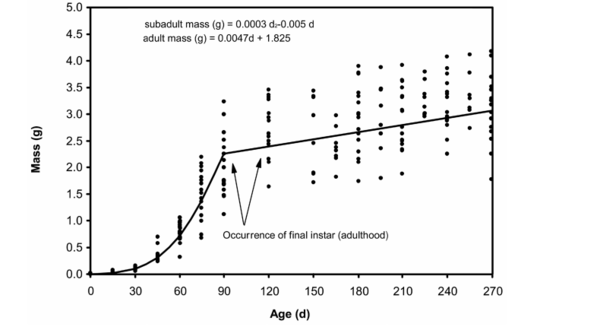
Within a normal range, the exact diet does not seem to change how fast hissing cockroaches grow or how big they get. In a feeding study that compared a 24 percent protein dog-food diet with a 31 percent protein cat-food diet, the growth rate and body mass of the cockroaches were not significantly different between the two diets, either in the parents or in their offspring (Figure 1).[5] A separate study raised hissing cockroaches on higher and lower nutrition and again found no significant difference in adult size or in how long they took to develop.[6]
Both diets in the first study held about 12 percent moisture and came with water available at all times, and under those conditions the roaches bred on a large scale, each group producing close to 2,000 offspring with very low (1 to 2 percent) death among the young.[5] That points to steady moisture and a balanced everyday diet mattering more for breeding than the precise protein level.
Calcium has a known role in cockroach biology, but the clearest evidence comes from a different species. In the cockroach Diploptera punctata, calcium acts as a signal inside the glands that control juvenile hormone, a hormone tied to reproduction and development.[7] That is a related-species result, and the study did not link it directly to how much calcium is in the diet, so it is best read as background rather than a feeding rule for hissing cockroaches.[7]
What to avoid, and how to give water
The research does not name a list of foods that are toxic to hissing cockroaches, but it does flag two clear hazards. The first is mold. Any food that turns wet or rotten should be removed promptly, because moldy food and damp conditions let fungi such as Aspergillus, Mucor, and Rhizopus build up in the enclosure, which is a concern for the colony and, through airborne spores, for people with weak immune systems.[4][9]
The second is pesticide residue. Food contaminated with Roundup (glyphosate) caused nerve and movement problems in hissing cockroaches, so produce that may carry pesticides should be washed or avoided.[8]
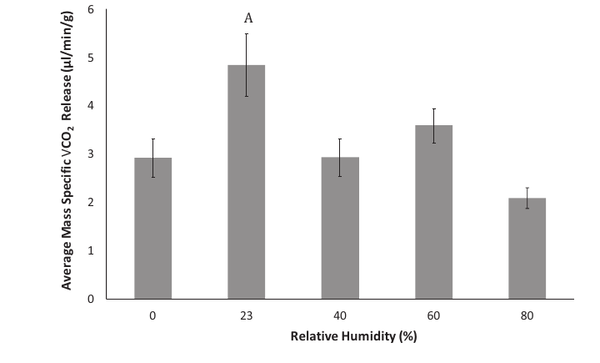
Water should be offered in a way that the roaches cannot drown in. Safe methods include a shallow dish filled with aquarium stones or a sponge to give nymphs a place to stand, or a cotton wick run through the lid of a closed water container so the roaches drink from the damp wick.[4][2] High-water fruits and vegetables, such as apple or potato slices, can also supply moisture on their own.[4] The enclosure needs some humidity but not a soggy floor. Light occasional misting and good airflow keep the air moist while holding back mold, and standing water that mixes with droppings should be cleaned up.[2][4] This humid setup also suits the cockroach itself, which shifts its breathing pattern to save water in dry air (Figure 2).[10][11]
Open questions
What do they really eat in the wild, beyond fallen fruit?
The published descriptions of the wild diet point mainly to ripe fruit on the forest floor.[1] The popular idea that hissing cockroaches eat all sorts of decaying leaves, fungi, and dead animals is plausible for a forest-floor scavenger, but we did not find gut-content studies, droppings analysis, or field observations that actually measure it. Direct diet studies on wild animals would settle how much of their food is fruit versus other litter.
What is this species' role in its ecosystem?
We can say cockroaches in general help break down plant matter, and that gut bacteria help them do it, but the studies we found on those bacteria were done in other cockroach species rather than in Gromphadorhina portentosa itself. We did not find research that measures this species' specific contribution to decomposition or nutrient cycling in the Madagascar rainforest. That ecological role is essentially unstudied in our sources.
How much does calcium in the diet matter for the roaches themselves?
Whole hissing cockroaches are low in calcium, which is why keepers add calcium when raising them as food for other pets.[3] What is less clear is whether extra dietary calcium changes the cockroaches' own health, molting, or breeding. The one mechanism linking calcium to reproduction comes from a different cockroach species and was not tied to diet.[7] A feeding trial that varied calcium and tracked growth and egg production in this species would answer it directly.
References
- Monahan CF, Bogan JE Jr, LaDouceur EEB (2023). Histological findings in captive Madagascar hissing cockroaches (Gromphadorhina portentosa) and a literature review. Veterinary Pathology. PubMed
- Mulder P (2016). Madagascar Hissing Cockroaches: Information and Care. Oklahoma State University Cooperative Extension Service, Fact Sheet L-278. OSU Extension
- Cerreta AJ, Smith DC, Ange-Van Heugten K, Minter LJ (2022). Comparative nutrient analysis of four species of cockroaches used as food for insectivores by life stage, species, and sex. Zoo Biology. PubMed
- Chua J, Fisher NA, Falcinelli SD, DeShazer D, Friedlander AM (2017). The Madagascar hissing cockroach as an alternative non-mammalian animal model to investigate virulence, pathogenesis, and drug efficacy. Journal of Visualized Experiments. PubMed
- McCue MD (2008). Endogenous and environmental factors influence the dietary fractionation of 13C and 15N in hissing cockroaches Gromphadorhina portentosa. Physiological and Biochemical Zoology. PubMed
- Mishra S, Logue DM, Abiola IO, Cade WH (2011). Developmental environment affects risk-acceptance in the hissing cockroach, Gromphadorhina portentosa. Journal of Comparative Psychology. PubMed
- Marchal E, Hult EF, Huang J, Stay B, Tobe SS (2013). Diploptera punctata as a model for studying the endocrinology of arthropod reproduction and development. General and Comparative Endocrinology. PubMed
- Kanabar M, Bauer S, Ezedum ZM, Dwyer IP, Moore WS, Rodriguez G, et al. (2021). Roundup negatively impacts the behavior and nerve function of the Madagascar hissing cockroach (Gromphadorhina portentosa). Environmental Science and Pollution Research. PubMed
- Yoder JA, Glenn BD, Benoit JB, Zettler LW (2008). The giant Madagascar hissing-cockroach (Gromphadorhina portentosa) as a source of antagonistic moulds: concerns arising from its use in a public setting. Mycoses. PubMed
- Yoder JA, Hedges BZ, Benoit JB, Keeney GD (2009). Role of permanent host association with the Madagascar hissing-cockroach, Gromphadorhina portentosa, on the developmental water requirements of the mite, Gromphadorholaelaps schaeferi. Journal of Comparative Physiology B. PubMed
- Vrtar A, Toogood C, Keen B, Beeman M, Contreras HL (2018). The effect of ambient humidity on the metabolic rate and respiratory patterns of the hissing cockroach, Gromphadorhina portentosa (Blattodea: Blaberidae). Environmental Entomology. PubMed
This deep dive backs the feeding section of the care guide.
Short, cited reads from the lab.