 Hisser Lab
 Buy on Amazon
Do hissing cockroaches really give live birth?
A female hisser seems to give birth to dozens of live young. What actually happens is a little different, and more interesting. This is the research.
At a glance
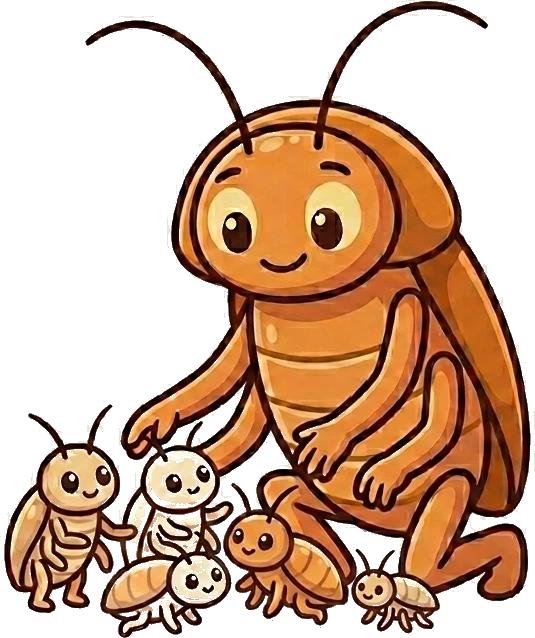
The female Gromphadorhina portentosa carries her fertilized eggs inside an egg case (an ootheca) held within her body, instead of dropping it outside. The eggs hatch inside her, and she then pushes the live nymphs out, so she looks like she gives birth. This is called ovoviviparity, and it is not the same as mammalian live birth, because each embryo lives on the yolk in its own egg rather than being fed by the mother.
- Reproductive mode
- Ovoviviparity (live-bearing, eggs hatch inside the female)
- Egg case
- Ootheca held internally, in a brood pouch
- Young born
- Live nymphs, about 20 to 50 per brood
- Embryo food
- Yolk in each egg, not nutrients from the mother
- Gestation
- About 60 days in the lab, then 2 to 3 broods a year
How does a hisser actually reproduce?
The Madagascar hissing cockroach (Gromphadorhina portentosa) is ovoviviparous, which means the fertilized eggs are kept and incubated inside the female before they hatch.[1] Its whole family, the Blaberidae, is described this way.[2] After mating, the female forms an egg case (an ootheca) and holds it inside a brood pouch in her body rather than dropping it on the ground.[1] The eggs develop there for about 60 days under lab conditions, then hatch inside her, and she pushes the live nymphs out of her body.[1][3] Because the young appear as moving nymphs and not as a dropped egg case, it looks like live birth, which one report describes as resembling "the birthing of live young."[1][3] We did not find published measurements of the ootheca's structure in this species, so this page sticks to what the research actually documents.
Is this the same as the live birth that mammals do?
No. The key question is what feeds the embryos. In ovoviviparity, each embryo lives on the yolk stored in its own egg, and the mother supplies protection and water but not food.[4] The eggs simply hatch inside her instead of outside. That is different from true viviparity, where the mother actively feeds the growing young, much as a placenta does in mammals.[4] Among cockroaches, only one species is known to do this: the Pacific beetle cockroach, Diploptera punctata. Its eggs carry little yolk, and the developing young are nourished directly by a "milk-like" secretion from the wall of the brood sac.[4][5] This feeding is required: if the pregnancy is cut short, the offspring do not survive.[6] The hisser does none of this. It keeps its eggs safe and moist and lets them hatch inside, but the food is the yolk the eggs already carried, so it is ovoviviparous rather than truly viviparous.[4]
How many young, and how often?
A single brood is usually about 20 to 50 live nymphs.[7] Under good conditions (around 23 to 26 degrees Celsius), a female produces 2 to 3 broods a year.[7] Each brood takes roughly 60 days to develop inside her before the nymphs emerge.[3] The newborn nymphs then grow up gradually, molting through six nymphal stages and taking close to five months to reach adulthood.[1][3]
Why does the exact wording matter in the classroom?
Calling this "live birth" without explaining it can set up a misconception. Students who later study vertebrates learn that mammals feed their young through a placenta, which is true viviparity. The hisser only looks similar: its eggs hatch inside the mother, but the embryos run on their own yolk and the mother does not feed them.[4] A clear way to say it is that the hisser is "live-bearing by ovoviviparity," meaning the eggs hatch inside and the young are born alive, but each one is fed by its own yolk. The cockroach that does feed its young, Diploptera punctata, makes a good contrast case for showing what true live birth means.[4][5]
Open questions
Does the mother give the eggs anything beyond yolk?
For ovoviviparous cockroaches, the rule of thumb is that the brood pouch supplies protection and water but not food, so the embryos run on their own yolk.[4] Most of the detailed work on this question has been done not on the hisser but on related species used as stand-ins, and on the milk-feeding Diploptera punctata at the other end of the scale.[4] We did not find a study that measures whether Gromphadorhina portentosa passes any small amount of extra nutrients or water to its eggs during the roughly two months they spend inside. Weighing eggs at laying and nymphs at hatching, or tracing labeled nutrients, would settle it.
How big is a brood, and what tells the mother it is time to give birth?
The numbers most often repeated for the hisser, about 20 to 50 young per brood and 2 to 3 broods a year, trace back to a few captive husbandry reports rather than to a dedicated study of this species.[7] Even the gestation length is given as a rough figure of about 60 days under lab conditions, and development times to maturity range from roughly 3 to 5 months across different reports.[3] No one has shown what actually triggers birth: whether it is a set number of days, a hormone signal, the embryos finishing development, or some cue from the mother. Careful counts across many timed broods, paired with measurements of the female during gestation, would pin these numbers down.
Why did the hisser stay ovoviviparous while a relative evolved true live birth?
One cockroach, Diploptera punctata, evolved true viviparity and feeds its embryos a protein-rich "milk" from the brood sac wall.[4][5] Most blaberid cockroaches, including the hisser, kept the simpler ovoviviparous mode where the young live on their own yolk. Why one lineage made the jump to mother-feeding and the others did not is not known. It would take a comparison of brood-sac anatomy, gene activity, and ecology across many species to say whether the difference comes from diet, body size, habitat, or chance.
References
- Monahan CF, Bogan JE Jr, LaDouceur EEB (2023). Histological findings in captive Madagascar hissing cockroaches (Gromphadorhina portentosa) and a literature review. Veterinary Pathology. PubMed
- Oladipupo SO, Laidoudi Y, Beckmann JF, Hu XP, Appel AG (2023). The prevalence of Wolbachia in multiple cockroach species and its implication for urban insect management. Journal of Economic Entomology. PubMed
- Mulder P (2016). Madagascar Hissing Cockroaches: Information and Care. Oklahoma State University Cooperative Extension Service, Fact Sheet L-278. OSU Extension
- Banerjee S, Coussens NP, Gallat FX, Sathyanarayanan N, Srikanth J, Yagi KJ, et al. (2016). Structure of a heterogeneous, glycosylated, lipid-bound, in vivo-grown protein crystal at atomic resolution from the viviparous cockroach Diploptera punctata. IUCrJ. PubMed
- Jennings EC, Korthauer MW, Hendershot JM, Bailey ST, Weirauch MT, Ribeiro JMC, et al. (2020). Molecular mechanisms underlying milk production and viviparity in the cockroach, Diploptera punctata. Insect Biochemistry and Molecular Biology. PubMed
- Jennings EC, Korthauer MW, Hamilton TL, Benoit JB (2019). Matrotrophic viviparity constrains microbiome acquisition during gestation in a live-bearing cockroach, Diploptera punctata. Ecology and Evolution. PubMed
- Carvalho TSG, Saad CEDP, Esposito M, Faria PB, Alvarenga RR, Ferreira LG, et al. (2019). Reproductive characteristics of cockatiels (Nymphicus hollandicus) maintained in captivity and receiving Madagascar cockroach (Gromphadorhina portentosa) meal. Animals. PubMed
This deep dive backs the "Breeding & life cycle" section of the care guide.
Short, cited reads from the lab.