 Hisser Lab
 Buy on Amazon
What lives inside a hissing cockroach that helps it digest?
A hisser eats fruit, leaves, and other tough scraps. It does not do that alone. This is the research on the microbes that make its diet work.

At a glance
A hisser does not digest its food alone. Gromphadorhina portentosa carries a community of gut bacteria that help process food, plus a separate bacterial partner called Blattabacterium that lives inside its body fat. Blattabacterium turns the roach's own nitrogen waste back into usable building blocks and supplies vitamins and amino acids the roach cannot make for itself. Together these microbes are a big part of why a hisser can live well on tough, low-value plant scraps.
- Main inner partner
- Blattabacterium, an obligate bacterial endosymbiont
- Where it lives
- Inside special cells (bacteriocytes) in the fat body, not the gut
- What it does
- Recycles nitrogen waste and makes amino acids and vitamins for the roach
- How it is inherited
- Passed straight from mother to egg before the shell forms
- Gut microbes
- A separate bacterial community that helps break down food and makes antimicrobial compounds
What microbes does a hisser carry?
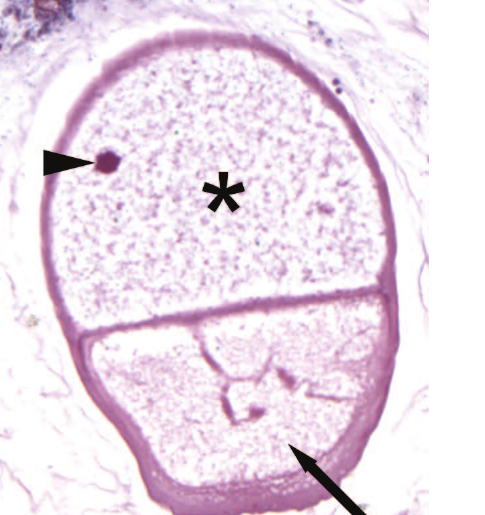
A hisser carries two very different kinds of microbe, and it helps to keep them apart. The first is the gut microbiome, a mixed community of bacteria living in the digestive tract. The second is a single bacterium, Blattabacterium, that lives deep inside the body's fat tissue rather than in the gut. Both are found across cockroaches, and both have been studied in the hisser and its relatives.
From the hisser's gut, researchers have grown and named bacteria directly. One, named Entomobacter blattae, was found all along the gut, from the oesophagus to the rectum, and turned out to be a brand-new genus of bacterium.[1] Another, a strain of Rhodococcus rhodochrous, was also cultured from the hisser gut.[1] In cockroaches more broadly, the gut community is dominated by a few main groups of bacteria.[2] A close look at captive hissers also found single-celled eukaryotes in the body: a fungal-type microbe resembling Nephridiophaga in the Malpighian tubules (the insect's kidney-like organs), treated as a harmless commensal, and gregarine parasites in the midgut that can cause disease when they build up (Figure 1).[3]
What does the fat-body symbiont do?
Blattabacterium is an obligate endosymbiont, meaning the roach and the bacterium cannot live without each other. It sits inside special host cells called bacteriocytes in the fat body, the insect's main storage and metabolism tissue.[2] Over millions of years it has thrown away most of its DNA and kept the parts that matter to its host: the pathways for making all of the essential amino acids and for recycling nitrogen.[6][7]
The nitrogen part is the clever trick. Cockroaches store nitrogen as uric acid in the fat body, using it as a reserve rather than throwing it away as waste.[5] When that reserve is tapped, the host breaks uric acid down to urea, and Blattabacterium then uses an enzyme called urease to turn the urea into ammonia.[4][5] That ammonia, which would otherwise be a toxic waste, is fed back into making amino acids the roach can use.[5] The partner converts the roach's own waste nitrogen into useful nutrition, a real advantage on a low-protein plant diet.[5] Much of this fine detail comes from other cockroaches such as Blattella germanica and Blaberus giganteus, whose Blattabacterium genomes have been sequenced and shown to carry the full set of amino acid and nitrogen-recycling genes.[4][7] The hisser is part of the same group of cockroaches that all carry this symbiont.[2]
How do the young get their microbes?
The two kinds of microbe are passed on in two different ways. Blattabacterium is inherited directly from the mother. It enters the egg cell during the mother's ovary development, before the egg shell forms, so every offspring is born already carrying it.[2] In fact it is the only bacterium found inside cockroach eggs, which shows it is handed down reliably from one generation to the next and not picked up from the environment.[2]
The gut bacteria work the opposite way. They are not inside the egg, so newly hatched young start nearly empty and pick up their gut community after birth, most likely by feeding on droppings and other shared material in the nest.[2] The gut bacterial load then jumps sharply, by about a hundredfold, between the first and second juvenile stages as most of the community moves in.[2] Much of this work was done in the closely related cockroach Blattella germanica; the broad pattern is shared across cockroaches, but the step-by-step detail has not been worked out in the hisser itself.[2][8]
Why does this matter for keepers?
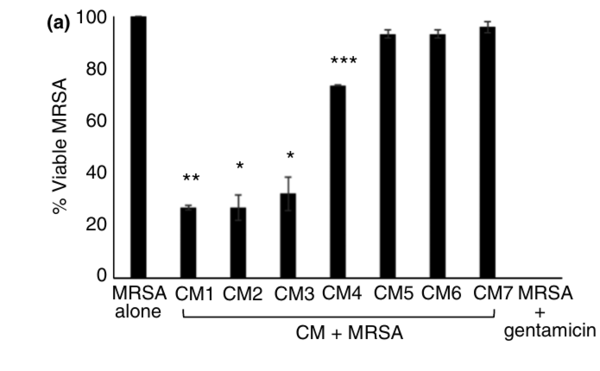
These microbes are why a hisser does so well on simple, low-cost food. The gut bacteria do more than break down meals. In cockroaches, gut microbes drive normal growth of the gut itself; roaches raised with no gut bacteria at all end up with shorter, weaker guts and absorb nutrients poorly.[10] Gut bacteria grown from the hisser and from the related Blaptica dubia also make compounds that kill a range of harmful bacteria and even a disease-causing amoeba (Figure 2), which may help the roach stay healthy in a dirty environment.[9]
For a keeper, a healthy gut community is part of a healthy roach, so the goal is steady, varied food rather than anything special. Cockroach gut communities are fairly stable: in the American cockroach the core gut microbiome held steady across very different diets, with only starvation and a pure-fat diet causing clear physical effects.[11] No controlled diet study has yet been run on the hisser's gut community, so how captive menus shift its microbiome in particular is still an open question.[11]
Open questions
How much of the nitrogen-recycling story is confirmed in the hisser itself?
Most of the detailed biology of Blattabacterium, the genome sequencing, the nitrogen chemistry, and the amino acid pathways, comes from other cockroaches such as Blattella germanica and Blaberus giganteus, not from Gromphadorhina portentosa.[4][7] The hisser belongs to the same group of cockroaches that all carry this symbiont, so it is reasonable to expect the same machinery, but direct measurements in the hisser are thin.[2] Sequencing the hisser's own Blattabacterium and testing its urease and amino acid output would show how much of the shared story really holds in this species.
What is the full list of microbes in the hisser's gut?
Only parts of the hisser's gut community have been described. The clearest hisser-specific work has named a few bacteria grown from its digestive tract, such as Entomobacter blattae and a strain of Rhodococcus rhodochrous.[1] Those are culture-based studies, which catch only the bacteria that grow in a dish and miss the many that do not. No full DNA survey of the hisser's gut has been published yet, so the complete census of who lives there, and in what numbers, is still unknown. A modern sequencing study of the whole community would fill in the rest.
Does captive diet change the hisser's gut community?
How diet shifts the hisser's gut microbes has not been tested directly. What we know comes from other species: in the American cockroach the core gut community held steady across very different diets, with only starvation and a pure-fat diet causing clear effects.[11] Whether the hisser's community is just as stable, and how varied feeder menus change it, is still an open question. A controlled feeding trial that tracked the hisser's gut bacteria over different diets would settle it.
References
- Guzman J, Sombolestani AS, Poehlein A, Daniel R, Cleenwerck I, Vandamme P, et al. (2019). Entomobacter blattae gen. nov., sp. nov., a new member of the Acetobacteraceae isolated from the gut of the cockroach Gromphadorhina portentosa. International Journal of Systematic and Evolutionary Microbiology. PubMed
- Carrasco P, Perez-Cobas AE, van de Pol C, Baixeras J, Moya A, Latorre A (2014). Succession of the gut microbiota in the cockroach Blattella germanica. International Microbiology. PubMed
- Monahan CF, Bogan JE Jr, LaDouceur EEB (2023). Histological findings in captive Madagascar hissing cockroaches (Gromphadorhina portentosa) and a literature review. Veterinary Pathology. PubMed
- Lopez-Sanchez MJ, Neef A, Pereto J, Patino-Navarrete R, Pignatelli M, Latorre A, et al. (2009). Evolutionary convergence and nitrogen metabolism in Blattabacterium strain Bge, primary endosymbiont of the cockroach Blattella germanica. PLoS Genetics. PubMed
- Patino-Navarrete R, Piulachs MD, Belles X, Moya A, Latorre A, Pereto J (2014). The cockroach Blattella germanica obtains nitrogen from uric acid through a metabolic pathway shared with its bacterial endosymbiont. Biology Letters. PubMed
- Gonzalez-Domenech CM, Belda E, Patino-Navarrete R, Moya A, Pereto J, Latorre A (2012). Metabolic stasis in an ancient symbiosis: genome-scale metabolic networks from two Blattabacterium cuenoti strains, primary endosymbionts of cockroaches. BMC Microbiology. PubMed
- Huang CY, Sabree ZL, Moran NA (2012). Genome sequence of Blattabacterium sp. strain BGIGA, endosymbiont of the Blaberus giganteus cockroach. Journal of Bacteriology. PubMed
- Beasley-Hall PG, Kinjo Y, Rose HA, Walker J, Foster CSP, Kovacs TGL, et al. (2024). Shrinking in the dark: parallel endosymbiont genome erosions are associated with repeated host transitions to an underground life. Insect Science. PubMed
- Akbar N, Siddiqui R, Iqbal M, Sagathevan K, Khan NA (2018). Gut bacteria of cockroaches are a potential source of antibacterial compound(s). Letters in Applied Microbiology. PubMed
- Jahnes BC, Poudel K, Staats AM, Sabree ZL (2021). Microbial colonization promotes model cockroach gut tissue growth and development. Journal of Insect Physiology. PubMed
- Tinker KA, Ottesen EA (2016). The core gut microbiome of the American cockroach, Periplaneta americana, is stable and resilient to dietary shifts. Applied and Environmental Microbiology. PubMed
This deep dive backs the "Food" section of the care guide.
Short, cited reads from the lab.