 Buy on Amazon
Why can't a tropical roach take over a temperate house?
A common worry is that a hisser could infest a home like a pest roach. The biology says it cannot. This is the research on why.

At a glance
The Madagascar hissing cockroach (Gromphadorhina portentosa) is a tropical rainforest insect that needs steady warmth and high humidity to stay active and to breed. A normal temperate house, especially in winter, is too cool and too dry for it to raise young. It is also a slow, wingless, slow-breeding animal, so an escaped roach is a single insect you can find and catch, not the start of an infestation.
- Origin
- Humid rainforest floor of Madagascar
- Needs to stay active
- About 22 to 30 C; sluggish below ~21 C
- Needs to breed
- Warmth (28 to 30 C) plus high humidity
- Cold tolerance
- Poor; a close relative dies after sustained freezing
- Breeding speed
- Slow: live-bearing, weeks of gestation, months to mature
What does a hisser need to survive and breed?
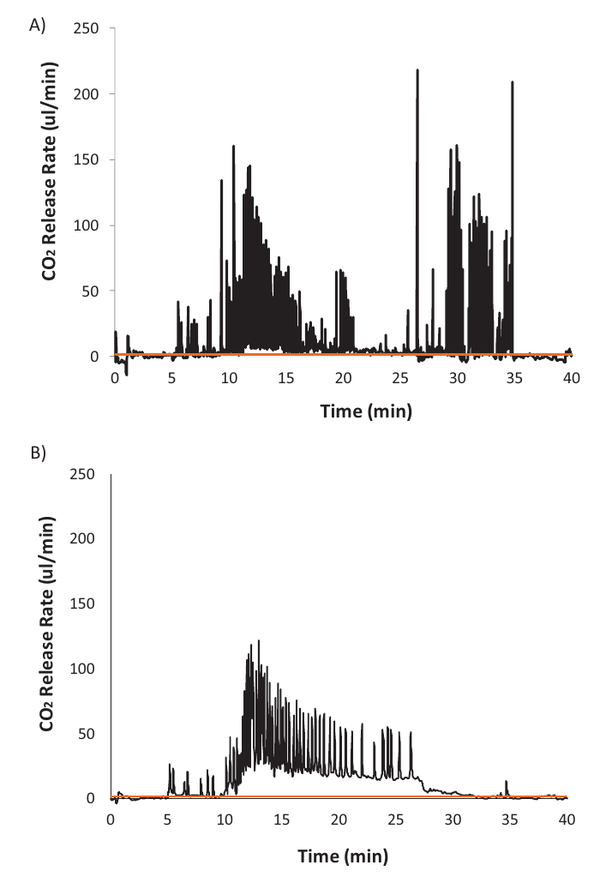
This is a tropical animal with tropical needs. In the wild it lives on the floor of humid Madagascan forest that gets roughly 1,000 to 3,800 mm of rain a year, and lab colonies are kept in warm, moist conditions, for example a steady 28 C and 80% relative humidity.[1] Keepers run enclosures anywhere from about 21 to 30 C, and the roaches stay active in a band of roughly 22 to 27 C.[2][3] Below about 21 C they turn sluggish and stop moving much, and conditions below about 18 C are not viable for them.[3]
Breeding has an even narrower window. Activity and breeding pick up only when it is warm, above about 27 C, and nymphs are reared fastest at 28 to 30 C; holding adults cooler, near 21 C, is used on purpose to slow breeding down.[2][3] Humidity matters as much as heat. A hisser carries more body water in moist air (about 76% of its mass at 80% humidity versus 71% at 0%), and it shifts its breathing to save water when the air is dry (Figure 1), so dry air leaves it drier and more stressed.[1] In short, raising young takes the warm, damp air of a terrarium, not the cooler, drier air of an ordinary home.
How well does it handle cold and dry air?
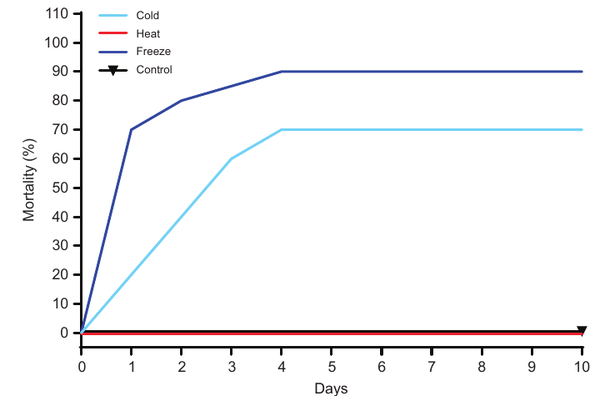
Direct cold-tolerance numbers for G. portentosa itself have not been published, so the best evidence comes from a close relative, the cockroach Gromphadorhina coquereliana. We treat it as a stand-in, not as a measurement of the pet hisser. In its Madagascan home, nighttime temperatures occasionally dip below about 5 C for a few hours, and the cockroach can shrug off that kind of brief chill by shifting its body chemistry.[4] Sustained cold is a different story. This species freezes at around -4.7 C, and once partial ice forms inside it the damage is slow but severe: about 20% of animals die within a day and 70% within four days, rising to 90% after a deeper freeze (Figure 2).[5] Even surviving short chills is costly, because fighting cold burns through the energy the insect would otherwise use to grow and reproduce.[6]
Dry air is the other limit. A hisser controls its breathing holes to slow water loss, which helps it cope with a range of humidity, but its overall water balance is still better in moist air, and it is simply not an animal of dry places.[1] The moist film around its body is real enough that its specialized mites depend on it and dry out in ordinary room air.[7] A temperate home swings cool in winter and runs dry under heating, so even indoors it rarely offers the steady warmth and damp that breeding requires.
What actually happens if one escapes?
A single escaped hisser is just that, a single insect. The adults are wingless, move slowly, and tend to wander toward warm, hidden, damp spots rather than spreading through a house. One roach also cannot found a population by itself. Even where many roaches escape at once, establishment depends on the new climate matching the animal's needs, on enough animals arriving, and on warmth lasting long enough to complete a life cycle.[8] In practice a lost hisser usually slows down in the cool, dry air, stays findable, and turns up near a heat source or behind furniture. The likely outcome is that you catch it and put it back, not that it disappears into the walls and multiplies.
How is it different from a household pest roach?
Most cockroaches are not pests at all; only about 1% of cockroach species live in human dwellings, and the hisser is not one of them. It is kept in classrooms, zoos, and homes as a large, tame, easy pet, and in the wild it lives on the rainforest floor among leaf litter and fallen fruit, with no pull toward houses.[9] The true indoor pests, the German cockroach (Blattella germanica) and the American cockroach (Periplaneta americana), are different animals. The German cockroach is specifically adapted to the indoor environment: its nymphs survive longer in the cold than their outdoor relatives, they develop quickly across a wide temperature range, and they are small and flat enough to pack into wall voids and cracks.[10] Pest roaches also breed fast, packaging dozens of eggs at a time and running many generations a year, which lets a few stowaways become an infestation.
The hisser does the opposite on every count. It is large and bulky, so it cannot vanish into wall cracks; it breeds slowly, carrying its eggs internally and giving birth to live young after weeks of gestation, with months more before those young mature; and it has no evolutionary history of living in buildings. The closest thing to an exception comes from Malta, where hissers that escaped from the pet trade did turn up in houses and gardens, but they stayed tied to warm, damp, human-made spots and never spread into the wild countryside, exactly because their tropical biology keeps them dependent on moist, sheltered microclimates.[11]
Open questions
What are the exact cold and dry limits for the pet hisser itself?
The hard numbers in this article (freezing point, freeze survival, the energy cost of cold) come from a close relative, Gromphadorhina coquereliana, not from G. portentosa itself.[5][6] Published lower lethal temperatures and minimum breeding conditions for the pet species specifically have not been measured, so we lean on the relative and on its tropical biology. The two are close enough that the picture is unlikely to change, but a direct study would pin it down.
How dry an environment can a hisser actually tolerate?
We know dry air costs the hisser water and raises its stress, because its metabolism shifts and it holds far less body mass at low humidity.[1] What is missing is a measured threshold: nobody has published the humidity floor below which the pet species cannot survive or breed, since the existing study mapped the response to dry air rather than the point of failure. That gap does not change the conclusion. A tropical species this sensitive to dry air is the opposite of one that could spread through ordinary, dry indoor rooms.
Could a warm, humid indoor spot let a small group hang on?
The Malta case shows the realistic edge: escaped hissers persisted in warm, damp, human-made spots such as heated buildings and gardens, but stayed tied to those microclimates and did not spread into the wild.[11] A heated basement, a greenhouse, or an unattended terrarium could in principle hold a few animals longer than a normal room would. For a group to actually breed and persist it would need sustained warmth above about 27 C and high humidity for months on end, which is why establishment outside the tropics depends on the local climate matching the animal rather than on the roach adapting to it.[8]
References
- Vrtar A, Toogood C, Keen B, Beeman M, Contreras HL (2018). The effect of ambient humidity on the metabolic rate and respiratory patterns of the hissing cockroach, Gromphadorhina portentosa (Blattodea: Blaberidae). Environmental Entomology. PubMed
- Chua J, Fisher NA, Falcinelli SD, DeShazer D, Friedlander AM (2017). The Madagascar hissing cockroach as an alternative non-mammalian animal model to investigate virulence, pathogenesis, and drug efficacy. Journal of Visualized Experiments. PubMed
- Mulder P (2016). Madagascar Hissing Cockroaches: Information and Care. Oklahoma State University Cooperative Extension Service, Fact Sheet L-278. OSU Extension
- Chowanski S, Lubawy J, Spochacz M, Ewelina P, Grzegorz S, Rosinski G, et al. (2015). Cold induced changes in lipid, protein and carbohydrate levels in the tropical insect Gromphadorhina coquereliana. Comparative Biochemistry and Physiology Part A. PubMed
- Lubawy J, Daburon V, Chowanski S, Slocinska M, Colinet H (2019). Thermal stress causes DNA damage and mortality in a tropical insect. Journal of Experimental Biology. PubMed
- Chowanski S, Lubawy J, Paluch-Lubawa E, Golebiowski M, Colinet H, Slocinska M (2025). Metabolism dynamics in tropical cockroach during a cold-induced recovery period. Biological Research. PubMed
- Yoder JA, Hedges BZ, Benoit JB, Keeney GD (2009). Role of permanent host association with the Madagascar hissing-cockroach, Gromphadorhina portentosa, on the developmental water requirements of the mite, Gromphadorholaelaps schaeferi. Journal of Comparative Physiology B. PubMed
- Buckley LB, Arakaki AJ, Cannistra AF, Kharouba HM, Kingsolver JG (2017). Insect development, thermal plasticity and fitness implications in changing, seasonal environments. Integrative and Comparative Biology. PubMed
- Monahan CF, Bogan JE Jr, LaDouceur EEB (2023). Histological findings in captive Madagascar hissing cockroaches (Gromphadorhina portentosa) and a literature review. Veterinary Pathology. PubMed
- Peterson MK, Hu XP, Appel AG (2023). Differential development and survival of Blattella asahinai and Blattella germanica (Blattodea: Ectobiidae) at six constant temperatures. Journal of Economic Entomology. PubMed
- Bohn H, Sciberras A (2021). Cockroach (Blattodea, Blaberoidea) fauna of the Maltese Islands, with descriptions of two new species. Zootaxa. PubMed
This deep dive backs the FAQ on escapes and infestation.
Short, cited reads from the lab.