 Hisser Lab
 Buy on Amazon
How does temperature change how fast hissing cockroaches grow?
Hissers are ectotherms, so the room sets their pace. This is the research on how temperature drives growth, and how keepers use that dial.

At a glance
Gromphadorhina portentosa is an ectotherm, meaning it takes its body heat from the environment instead of making its own. Its metabolism, and with it how fast a nymph grows, rises and falls with the temperature of its enclosure. Warmth speeds growth and breeding while cool slows them, up to a point: past a certain warmth growth tails off again, so a keeper can use temperature as a dial within safe limits.
- Body heat
- From the environment (ectotherm)
- Metabolism
- Rises with temperature (measured by respirometry)
- Growth
- Faster when warm, slower when cool
- Thermal curve
- Hump-shaped: speeds to an optimum, then declines
- Care guides suggest
- Roughly 72 to 86 °F (about 22 to 30 °C); warmer to hasten growth
What does ectotherm mean for a hisser?
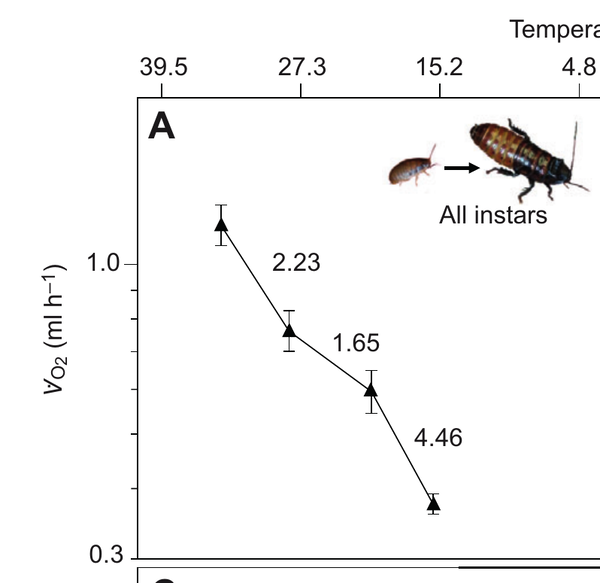
An ectotherm cannot make its own body heat the way a mammal does. Its body sits at roughly the temperature of its surroundings, so the warmth of the enclosure sets the speed of its chemistry. You can measure this directly. When researchers placed Gromphadorhina portentosa in a respirometer and warmed it, the rate at which it gave off carbon dioxide climbed steeply, from about 1.2 ml per minute at 10 °C to 6.4 ml at 20 °C and 13.8 ml at 30 °C.[1] Oxygen use rises the same way: average intake roughly doubled from 16 °C to 28 °C in one study (Figure 1).[2] Cold does the reverse. At 10 °C the roach barely breathes, keeping its spiracles (the breathing holes along its body) shut most of the time, and it opens them more and more as it warms.[1] Because every part of the animal runs on this temperature-driven engine, the heat of the room is the single biggest lever a keeper has over how fast a hisser lives and grows.
How much does warmth speed growth?
Honest caveat first: no one has yet published a full growth-versus-temperature study for Gromphadorhina portentosa itself, so there is no exact "grows fastest at X degrees" number for this species. What the literature does have is the shape of the response, measured in close relatives. In a study of a related blaberid cockroach (Nauphoeta cinerea), growth sped up as juveniles were reared warmer, peaked near 32 °C, then fell off again above that, with growth dropping by about a third by roughly 34.5 °C.[3] That hump shape, faster up to an optimum and then declining, is the rule for insect growth.
Development time also shortens as temperature climbs. In two pest cockroaches, total nymphal development fell from about 87 days at 20 °C to around 41 days at 25 °C and 34 days at 35 °C.[4] Push too far, though, and survival collapses: at 35 °C one of those species had almost no nymphs reach adulthood.[4] The lesson for a hisser is the same even without a species-specific number: a warmer enclosure shortens the road to adult size, a cooler one stretches it out, and there is an upper end where more heat stops helping.
What temperature suits breeding and a colony?
Again, the corpus has no controlled breeding-rate-versus-temperature experiment for this species, so the guidance comes from rearing notes rather than a model. A protocol that rears G. portentosa for research tells keepers to hold nymphs at 28 to 30 °C to hasten growth, and to drop large adults to about 21 °C for a couple of months when they want to slow breeding and pregnancy down.[5] Colonies have been kept healthy and breeding across a fairly broad band: one source reports good survival and 2 to 3 broods of 20 to 50 live young a year at about 23 to 26 °C.[6] A husbandry note puts the working range at roughly 72 to 80 °F (about 22 to 27 °C), adds that activity and breeding pick up above 80 °F, warns that below about 70 °F the roaches turn sluggish, and says not to let them sit below 65 °F.[7] The pattern across all of these is consistent: warm pushes breeding along, cool puts it on hold.
How do keepers and classrooms use this?
Entomologists capture the warmth-and-growth link with two ideas, both drawn from the wider insect literature rather than from hissers specifically. The first is the degree-day. Above a lower threshold temperature, where development first kicks in, an insect accumulates "heat units" each day, and it reaches the next stage once it has banked enough of them; warmer days bank heat faster, so the same milestone arrives sooner.[8][9] The second is the thermal performance curve, the hump-shaped graph of performance against temperature: development rate climbs over the cooler range, peaks at an optimum, then drops as heat starts to cost survival rather than buy speed.[8] Lowering temperature toward the threshold stretches development out; raising it, while staying below the danger zone, speeds development up.[10]
For a keeper the practical version is simple. To grow nymphs quickly or encourage breeding, keep the colony at the warm end of its range; to slow a colony down, hold it cooler. Closely-related species are a fair guide when a species has no numbers of its own.[9] For a classroom, temperature is a clean variable for a fair-test experiment: rear small groups at two safe temperatures and time the molts or weigh the nymphs. A welfare review of the related G. oblongonota recommends an enclosure of about 27 to 30 °C and reports no harm at high warmth, while noting that around 8 to 10 °C these roaches lose mobility in a "chill coma," a temporary, reversible shutdown they recover from once warmed back up.[11] Keep experiments inside the comfortable band and away from those extremes.
Open questions
What is the hisser's own degree-day model and developmental thresholds?
No one has published a degree-day model for Gromphadorhina portentosa, and no study has measured the temperatures at which its growth first starts and finally stops. The optimum near 32 °C and the upper drop-off that this page cites come from a related cockroach, Nauphoeta cinerea, not from hissers themselves.[3] Borrowing a close relative's numbers is reasonable, but it is not the same as measuring them. Settling this would take a straightforward study: rear hisser nymphs at a spread of constant temperatures, then time the molts to fit the species' own development curve and read off its lower threshold and degree-day requirement.
What temperature actually maximizes breeding in this species?
The temperatures keepers use for breeding come from rearing notes and care sheets, not from a controlled experiment that varied temperature and counted offspring. The published guidance does not even agree on one number: one rearing protocol keeps nymphs at 28 to 30 °C to hasten growth, while another source reports good breeding at about 23 to 26 °C.[5][6] These are practical ranges that work, not a measured optimum. Pinning down the true peak would mean breeding several groups across a span of steady temperatures and comparing brood size and timing.
Where are the safe upper and lower limits for each life stage?
The thermal limits for eggs, nymphs, and adults have not been mapped separately. What exists is a single acute lethal point: an adult hisser dies within about 40 minutes at 50 °C.[12] A brief lethal exposure is not the same as the temperature at which slow, long-term development stalls, and a young nymph may not share an adult's tolerances. Until someone tests each stage across a range of held temperatures, the safe boundaries stay rough estimates drawn from care guides and close relatives.
References
- Contreras HL, Bradley TJ (2010). Transitions in insect respiratory patterns are controlled by changes in metabolic rate. Journal of Insect Physiology. PubMed
- Streicher JW, Cox CL, Birchard GF (2012). Non-linear scaling of oxygen consumption and heart rate in a very large cockroach species (Gromphadorhina portentosa): correlated changes with body size and temperature. The Journal of Experimental Biology. PubMed
- Lombardi EJ, Bywater CL, White CR (2020). The effect of ambient oxygen on the thermal performance of a cockroach, Nauphoeta cinerea. The Journal of Experimental Biology. PubMed
- Peterson MK, Hu XP, Appel AG (2023). Differential development and survival of Blattella asahinai and Blattella germanica (Blattodea: Ectobiidae) at six constant temperatures. Journal of Economic Entomology. PubMed
- Chua J, Fisher NA, Falcinelli SD, DeShazer D, Friedlander AM (2017). The Madagascar hissing cockroach as an alternative non-mammalian animal model to investigate virulence, pathogenesis, and drug efficacy. Journal of Visualized Experiments. PubMed
- Carvalho TSG, Saad CEDP, Esposito M, Faria PB, Alvarenga RR, Ferreira LG, et al. (2019). Reproductive characteristics of cockatiels (Nymphicus hollandicus) maintained in captivity and receiving Madagascar cockroach (Gromphadorhina portentosa) meal. Animals. PubMed
- Mulder P (2016). Madagascar Hissing Cockroaches: Information and Care. Oklahoma State University Cooperative Extension Service, Fact Sheet L-278. OSU Extension
- Abarca M, Parker AL, Larsen EA, Umbanhowar J, Earl C, Guralnick R, et al. (2024). How development and survival combine to determine the thermal sensitivity of insects. PLoS One. PubMed
- Jarosík V, Honek A, Magarey RD, Skuhrovec J (2011). Developmental database for phenology models: related insect and mite species have similar thermal requirements. Journal of Economic Entomology. PubMed
- Buckley LB, Arakaki AJ, Cannistra AF, Kharouba HM, Kingsolver JG (2017). Insect development, thermal plasticity and fitness implications in changing, seasonal environments. Integrative and Comparative Biology. PubMed
- Free D, Wolfensohn S (2023). Assessing the welfare of captive group-housed cockroaches, Gromphadorhina oblongonota. Animals. PubMed
- McCue MD, De Los Santos R (2013). Upper thermal limits of insects are not the result of insufficient oxygen delivery. Physiological and Biochemical Zoology. PubMed
This deep dive backs the "Temperature" section of the care guide.
Short, cited reads from the lab.