 Hisser Lab
 Buy on Amazon
Why does a freshly molted hissing cockroach turn white?
Now and then a hisser looks ghostly white for a few hours. It has just molted. This is the research on what is happening to its body.

At a glance
When a Madagascar hissing cockroach (Gromphadorhina portentosa) molts, it sheds its old shell and the new one underneath is soft and pale, which is why the animal looks white. Over the next day the cuticle hardens and darkens through a tanning process called sclerotization. Until it has browned up and firmed up, the roach is fragile and easily hurt, so it should be left alone.
- Event
- Molt (ecdysis): the old shell is shed
- Why it looks white
- New cuticle is not yet tanned or pigmented
- What hardens it
- Sclerotization: catecholamines cross-link the cuticle proteins
- Main tanning window
- About the first 24 hours after the molt
- Molts to adult
- About six nymphal molts
What happens during a molt?
An insect's body is wrapped in a stiff outer shell, the cuticle, that cannot stretch much. To grow, the roach has to shed it and build a bigger one. This is called molting, or ecdysis. The animal grows a soft new cuticle underneath the old one, then splits and climbs out of the old shell, which is left behind as a pale, empty husk. The roach that crawls out is soft and pale, with a thin, see-through cuticle, and you can sometimes see internal organs through the back of its belly.[1] Right after the molt the new cuticle has not yet hardened or gained its color, so the animal is easy to injure and easy to spot, leaving it open to drying out, getting crushed, and being eaten.[1]
Most of the detailed timing has been measured in related cockroaches and other insects rather than in Gromphadorhina portentosa itself, but the chemistry of the new shell has been studied directly in this species.[2]
Why is the new exoskeleton white and soft?
A freshly molted roach is soft and white because its new cuticle has not yet gone through sclerotization and melanization, the two changes that harden it and give it color. Both happen only after the molt, so the new cuticle starts out pale and unhardened.[1] The color comes from molecules called catecholamines (chemical cousins of dopamine) that the skin lays into the cuticle and then links together. Until those links form and the pigment builds up, there is little color to see, so the cuticle looks white or translucent.[2] The same linking reactions are what make the shell stiff. Solid-state NMR studies of insect cuticle show that as tanning proceeds, catecholamines form strong, permanent chemical links between cuticle proteins and between proteins and chitin (the fibrous sugar that gives the cuticle its framework), and the cuticle becomes harder and drier as those cross-links pile up.[3] Before they form, the proteins are loose and the cuticle stays flexible, which is exactly what lets the roach swell to its new size before everything sets.[2]
How does the shell harden, and how long does it take?
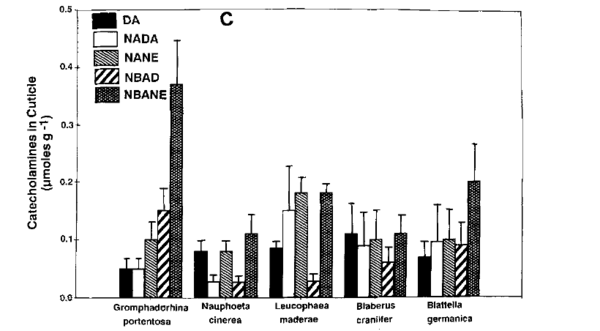
Hardening, or tanning, is driven by a chain of chemistry. The roach starts from the dietary amino acid tyrosine and turns it into catecholamines such as N-acetyldopamine (NADA) and N-β-alanyldopamine (NBAD), which are pumped into the new cuticle.[2] An enzyme called laccase-2 then oxidizes these molecules into reactive forms that glue the cuticle proteins together, the cross-linking that stiffens the shell. Studies in beetles and a moth confirmed that laccase is the enzyme responsible for this tanning.[4] The whole process is switched on by a hormone called bursicon, released after the molt, which triggers cuticle hardening. In the fruit fly, mutations that break bursicon leave the new cuticle poorly hardened.[5] The balance of these catecholamines also sets the shade. In the beetle Tribolium castaneum, blocking the supply of NBAD makes dopamine pile up and diverts it into black pigment, giving an abnormally dark, less cross-linked shell.[6] In G. portentosa, the N-β-alanyl catecholamines that drive sclerotization dominate, which fits its brown coloring rather than a deep black (Figure 1).[2][7]
The tanning happens fast. In cockroaches including G. portentosa, the big shifts in cuticle chemistry occur within the first 24 hours after the molt, and little change is reported after that, so the active hardening is largely finished within about a day.[2] During that window the soft cuticle can still be dented or bent out of shape by pressure, and the legs are especially easy to deform, so a white, freshly molted roach should not be picked up or handled until it has darkened and firmed up.
How many times does a hisser molt?
The Madagascar hissing cockroach goes through about six molts as a nymph, passing through six nymphal stages before it becomes an adult.[8][9] The young look like small versions of the adults and change gradually with each molt, a pattern called incomplete metamorphosis. From hatching, it takes a nymph about five months to reach adulthood.[8][9] Each molt produces the same soft, pale, vulnerable stage described above, so a healthy hisser turns white a handful of times on its way to adulthood.
Open questions
What is the full molting sequence in this species?
No published study lays out the step-by-step ecdysis sequence for Gromphadorhina portentosa from start to finish. The biochemistry of cuticle hardening and the hormones that control molting are worked out mostly in other insects, such as flour beetles and other cockroaches, and then assumed to apply here. The behavior we see (the old shell splitting, the pale roach pulling free, the body swelling) has not been tied together with the inside biology in one careful account for this animal. Filling the gap would take a timed study that watches hissers molt while tracking the matching hormonal and cuticle changes.
When is a freshly molted hisser fully hardened and safe again?
There is no measured endpoint for when a newly molted hisser is back to full strength. The chemistry of tanning has been tracked through about the first 24 hours after molting, and the dark tanning compounds make up roughly 80 percent of all the catecholamines in the shell by that point, but no one has reported what happens past 24 hours in this group.[2] So the exact hour when the cuticle stops softening and the roach can defend itself again is still a guess. Settling it would take measurements of cuticle hardness over several days after a molt, not just the first day.
How do temperature and humidity affect molting success?
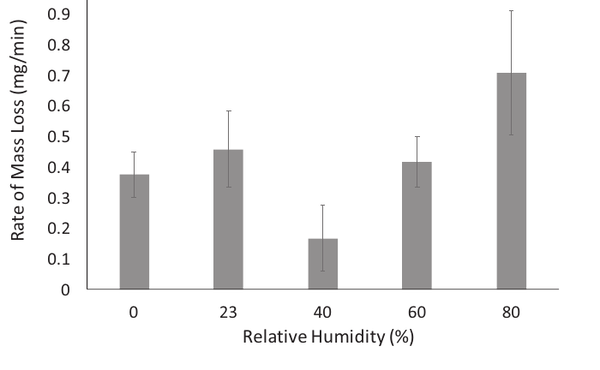
Keepers often blame failed molts on a tank that is too cold or too dry, but the published research does not yet pin this down. No study has measured how temperature or humidity changes molting success in Gromphadorhina portentosa. Care and welfare work lists comfortable temperatures for hissing cockroaches (with chilling and torpor setting in toward the low end and high heat raising the metabolic rate), but it does not connect those numbers to molting outcomes.[10] On humidity, one study of adult G. portentosa found they held their water balance steady across a wide range of moisture in the air, which suggests the species copes well with dry conditions, but that work looked at breathing and water loss, not at molting (Figure 2).[11] Settling the question would take controlled experiments that rear nymphs at set temperatures and humidities and record how many molt cleanly.
References
- Mullins DE, Nalepa CA, Mullins AJ, Gabbert SE (2025). Cuticular nitrogen economy during development in the cockroach Cryptocercus punctulatus and the termite Neotermes jouteli. Journal of Insect Physiology. PubMed
- Czapla TH, Hopkins TL, Kramer KJ (1990). Catecholamines and related o-diphenols in cockroach hemolymph and cuticle during sclerotization and melanization: comparative studies on the order Dictyoptera. Journal of Comparative Physiology B. PubMed
- Schaefer J, Kramer KJ, Garbow JR, Jacob GS, Stejskal EO, Hopkins TL, Speirs RD (1987). Aromatic cross-links in insect cuticle: detection by solid-state 13C and 15N NMR. Science. PubMed
- Suderman RJ, Dittmer NT, Kanost MR, Kramer KJ (2006). Model reactions for insect cuticle sclerotization: cross-linking of recombinant cuticular proteins upon their laccase-catalyzed oxidative conjugation with catechols. Insect Biochemistry and Molecular Biology. PubMed
- Dewey EM, McNabb SL, Ewer J, Kuo GR, Takanishi CL, Truman JW, Honegger HW (2004). Identification of the gene encoding bursicon, an insect neuropeptide responsible for cuticle sclerotization and wing spreading. Current Biology. PubMed
- Arakane Y, Lomakin J, Beeman RW, Muthukrishnan S, Gehrke SH, Kanost MR, Kramer KJ (2009). Molecular and functional analyses of amino acid decarboxylases involved in cuticle tanning in Tribolium castaneum. Journal of Biological Chemistry. PubMed
- Noh MY, Muthukrishnan S, Kramer KJ, Arakane Y (2016). Cuticle formation and pigmentation in beetles. Current Opinion in Insect Science. PubMed
- Mulder P (2016). Madagascar Hissing Cockroaches: Information and Care. Oklahoma State University Cooperative Extension Service, Fact Sheet L-278. OSU Extension
- Chua J, Fisher NA, Falcinelli SD, DeShazer D, Friedlander AM (2017). The Madagascar hissing cockroach as an alternative non-mammalian animal model to investigate virulence, pathogenesis, and drug efficacy. Journal of Visualized Experiments. PubMed
- Free D, Wolfensohn S (2023). Assessing the welfare of captive group-housed cockroaches, Gromphadorhina oblongonota. Animals. PubMed
- Vrtar A, Toogood C, Keen B, Beeman M, Contreras HL (2018). The effect of ambient humidity on the metabolic rate and respiratory patterns of the hissing cockroach, Gromphadorhina portentosa (Blattodea: Blaberidae). Environmental Entomology. PubMed
This deep dive backs the "Don't handle a white one" field note in the care guide.
Short, cited reads from the lab.