 Hisser Lab
 Buy on Amazon
How do male hissing cockroaches fight, and do the horns decide who wins?
Male hissers shove each other horn to horn and hiss while they do it. This is the research on how those contests work and what the horns are for.

At a glance
Male Madagascar hissing cockroaches (Gromphadorhina portentosa) fight by lowering their heads and shoving each other with the horns on the shield behind the head, all while hissing. The bigger, heavier male almost always wins. The horns are a male-only trait, but studies have not shown that horn size decides who wins, body weight does.
- Weapon
- Pronotal horns (paired bumps on the shield behind the head)
- Contest
- Head-down shoving and charging with the horns, plus hissing
- Sexual dimorphism
- Males large and textured horns, females small and smooth
- Best predictor of the winner
- Body weight (bigger male usually wins)
- Prize for winning
- Priority of access to females
What are the horns?
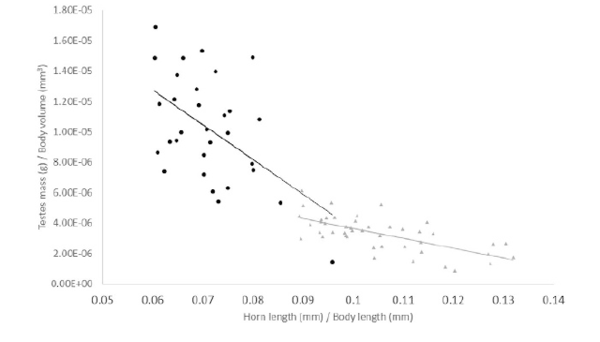
The “horns” are two large bumps (tubercles) on the top of the heavily armored plate behind the head, called the pronotum. They are so prominent that people often mistake them for eyes, but the real head sits underneath, tucked behind the armor (Figure 2).[1] Both sexes have the bumps, but they are not the same. In males they are large, raised, and textured; in females they are smaller and smooth. This difference is the main way to tell the sexes apart from the top.[1] The horns are a sexually selected male trait. Across the giant hissing cockroaches (a group of close relatives), species that invest more in long horns tend to invest less in testes mass, a trade-off between competing for mates before mating (weapons) and competing through sperm after mating (Figure 1).[2] In other words, the horns are built for male-male competition, even though, as the next sections show, their size does not settle a given fight in this species.[2]
How does a contest play out?
A contest is a mix of shoving, signaling, and backing down. Two males will fence with their antennae, then lower their heads and either charge (a fast hit with the horns) or push (a slow, steady shove with the horns).[3] Hissing runs through the whole thing. In one study, 118 of 200 males hissed during a 30-minute trial, and dominant males hiss more than subordinate ones.[4] The most aggressive moves on record are the butt (head down, rush forward, strike with the pronotum) and the lunge, and males also flick and thrash the abdomen.[5][6] A loser signals defeat by turning away, freezing flat against the ground, or retreating.[3][4] A male is scored as dominant when he performs clearly more aggressive acts than his rival; when neither male dominates, the encounter is a draw.[4] Certain moves track winning and losing: winners do more antennae fencing, abdomen lifts, long shakes, and side tilts, while losers do more freezing and turning away.[3]
Does the bigger or louder male usually win?
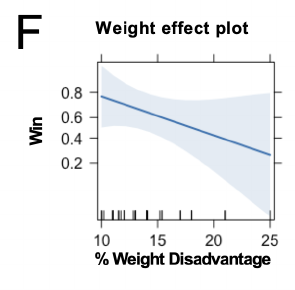
The bigger one. Body weight is the strongest predictor of who wins, and dominant males are reliably heavier than the males they beat.[4] In a 2026 study, a male's chance of winning rose steadily with his weight advantage over his opponent (Figure 3).[3] Hissing looks like a size signal rather than a separate deciding factor. Heavier males make longer, lower-pitched hisses, but once you account for weight, the hisses of dominant and subordinate males no longer differ. Hissing alone does not settle a contest; physical shoving is still needed.[4] Horn size is the surprise. No study of G. portentosa has shown that the male with the bigger horns wins; the work on contest outcome measured body weight, hissing, and specific fight moves, not horn length.[3] Past experience does not seem to matter much either. A male's total wins and losses did not differ by whether he had been given a recent win, and prior experience was not a significant predictor of outcome.[3]
What does a male gain by winning?
The documented prize is mates. Dominance in G. portentosa sets the "priority of access to females," and dominant males limit a subordinate's access to receptive females.[4] That is the clearest payoff in the record; no good evidence in these studies shows that winners control perches, territory, or other spots.[4] Hissing helps keep the peace after rank is set. Once a stable relationship forms between two males, hissing helps maintain it, so a settled pair does not have to fight from scratch every time.[4] There are hints that just having won a fight can give a male a brief edge. In the 2026 fighting trials, a male that had just won could sometimes beat an opponent that outweighed him by a small margin, where a fresh lighter male would usually back down.[3] Even so, across all fights, weight remained the dependable predictor and recent wins and losses did not add up to a lasting edge.[3]
Open questions
If horn size does not decide fights, what are the horns for?
The pronotal horns are clearly a male trait shaped by sexual competition, and across related giant hissing cockroaches they trade off against testes mass.[2] Yet the study that measured who wins fights in G. portentosa found that body weight, not horn size, predicted the outcome, and it did not test horn size on its own.[3] So the horns may work mainly as tools for pushing and bracing, as a display of size, or through female choice, and no one has shown which. A clean test would measure each male's horn size separately, hold body weight constant, and check whether horns still predict wins.
Do pheromones and juvenile hormone shape male fights in this species?
In a different cockroach, the lobster cockroach (Nauphoeta cinerea), a contact pheromone on the antenna and the hormone that controls it (juvenile hormone) help trigger attacks and set rank.[7] Whether anything similar operates in the Madagascar hissing cockroach has not been tested. Settling it would mean measuring antennal chemistry and juvenile hormone levels in G. portentosa males and linking them to fight outcomes.
Is there a real winner or loser effect?
In many animals, winning a fight makes a male more likely to win the next one, and losing makes him more likely to lose. A study in G. portentosa looked for this and found no effect of prior fight experience on later outcomes.[3] But its own power analysis showed that detecting a small effect would have needed about 765 contests, far more than were run, so a weak effect cannot be ruled out. A much larger experiment would be needed to settle whether one exists.
References
- Mulder P (2016). Madagascar Hissing Cockroaches: Information and Care. Oklahoma State University Cooperative Extension Service, Fact Sheet L-278. OSU Extension
- Durrant KL, Skicko IM, Sturrock C, Mowles SL (2016). Comparative morphological trade-offs between pre- and post-copulatory sexual selection in giant hissing cockroaches (tribe: Gromphadorhini). Scientific Reports. PubMed
- Young JJ, Craven CA, Koenig JA, Addemir M, He BZ, Miakotina OL, et al. (2026). Combat behaviors predictive of fight outcome in Gromphadorhina portentosa. microPublication Biology. PubMed
- Clark DC, Moore AJ (1995). Genetic aspects of communication during male-male competition in the Madagascar hissing cockroach: honest signalling of size. Heredity. PubMed
- Logue DM, Takahashi AD, Cade WH (2011). Aggressiveness and size: a model and two tests. The American Naturalist. PubMed
- Mishra S, Logue DM, Abiola IO, Cade WH (2011). Developmental environment affects risk-acceptance in the hissing cockroach, Gromphadorhina portentosa. Journal of Comparative Psychology. PubMed
- Chou SY, Huang ZY, Chen SC, Yang RL, Kou R (2007). Antenna contact and agonism in the male lobster cockroach, Nauphoeta cinerea. Hormones and Behavior. PubMed
This deep dive backs the "Males vs. females" section of the care guide.
Short, cited reads from the lab.