 Hisser Lab
 Buy on Amazon
How does a hissing cockroach make sound by breathing?
Most insects that make noise rub body parts together. Hissers force air through their breathing holes instead. This is the research on how that works.

Hear it. A 10-second disturbance hiss, the kind both sexes give when startled:
Recording by Spoxe, released CC0 via Freesound.
At a glance
The Madagascar hissing cockroach (Gromphadorhina portentosa) makes its hiss by squeezing its abdomen and forcing air out through a modified breathing hole, called a spiracle, on the side of its body. Almost all other noisy insects rub body parts together or buzz a membrane, so making sound by breathing out is unusual. The species makes three kinds of hiss: a disturbance hiss given by both sexes when startled, and two hisses that only males make, one during fights with other males and one during courtship.
- Sound source
- A modified abdominal spiracle (a breathing hole); sources disagree on which one
- Mechanism
- Air forced out by abdominal muscles, not wings or legs
- Hiss types
- Disturbance (both sexes), combat, and courtship (males only)
- Disturbance hiss pitch
- Broadband, roughly 0.8 to 4.6 kHz
- Male combat hiss
- About 0.6 s long, dominant frequency near 5 kHz
Where does the sound come from?
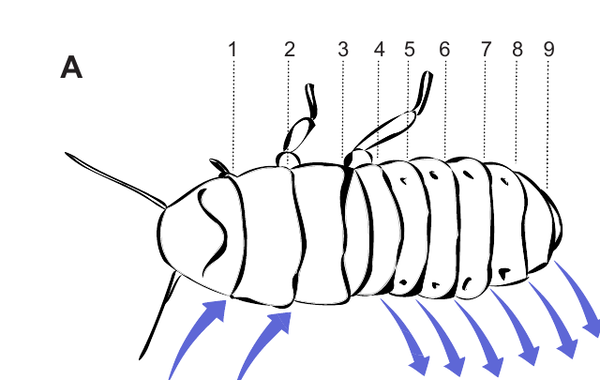
A cockroach breathes through small openings along its body called spiracles, which lead into air tubes (tracheae). To hiss, the roach closes most of these openings, contracts its abdomen, and pushes air out through one specialized pair (Figure 1); the rush of air makes the sound.[1] In the most detailed study, video of breathing roaches showed that this one pair of openings stays shut during normal breathing and opens only during a hiss, while the other abdominal spiracles open and close together to move air (Figure 2).[1] The cuticle closes so tightly around that opening that the researchers had to trim it back just to see the spiracle work, a sign of real structural change for sound.[1]
Which spiracle does the job is not fully settled. The breathing study identified it as the first abdominal spiracle (the third spiracle pair counting from the front, after the two on the thorax).[1] Other sources instead call the sound-producing opening the modified second abdominal spiracle.[2] One comparative paper places the modified opening on the fourth abdominal segment.[3] These differences come partly from different ways of numbering the segments, so the exact name varies between studies even though all agree the source is a modified abdominal spiracle that vents forced air.[1][2]
How is this different from how crickets or cicadas make sound?
Most insects that make noise do it by moving hard parts of the body. Crickets rub a file on one wing against a scraper on the other, a method called stridulation. Some cockroaches do something similar, rubbing rows of tiny pegs on one body segment against a ridge on the next.[3] Cicadas snap a stiff membrane called a tymbal in and out, and many insects also make sound just from the beat of their wings.[4] All of these turn a moving body part into sound.
The hissing cockroach is different because it uses moving air. It does not rub or vibrate anything; it forces air out through a spiracle, much like blowing through a narrow gap.[1][3] The width of the opening changes the sound: a fully open spiracle gives a broad, breathy hiss, while a partly closed one gives a purer, whistle-like tone.[8] Making sound this way, from breathing rather than from rubbing or buzzing, is uncommon among insects, though a few caterpillars also force air through a spiracle to whistle.[8]
Do the three hisses carry different messages?
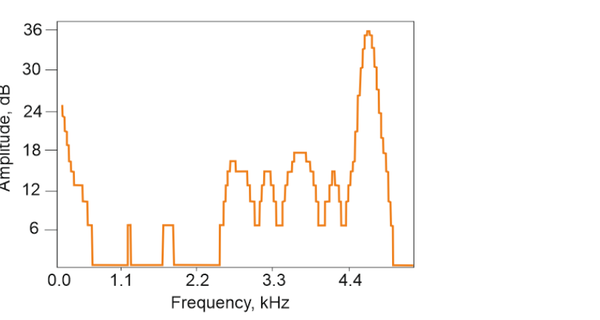
The disturbance hiss is the one most people hear. Older nymphs and adults of both sexes give it when they are touched or startled, and the harder the threat, the bigger the response: a light poke may bring a single hiss, while a strong threat brings a long string of hisses as the animal flees.[6] One recording found this hiss spans a broad range of roughly 0.8 to 4.6 kHz (kilohertz; higher numbers mean higher pitch), with the loudest parts around 3.3 to 4.5 kHz (Figure 3).[5]
The other two hisses are made only by males.[6] Males give a combat hiss while fighting other males over status, and a courtship hiss aimed at females.[7] In the main study of these two, the combat hiss averaged about 0.6 seconds long with a dominant frequency near 5 kHz, and the courtship hiss was about the same length and pitch as the combat hiss.[7] So while the behavior is different, these two male hisses sound much the same. No study has placed all three hiss types side by side with matching measurements, so direct acoustic comparison between the disturbance hiss and the male hisses is still limited.[5][7]
What does the hiss tell other roaches?
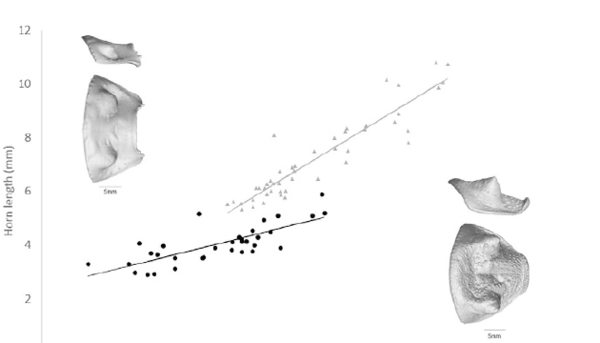
Among males, the hiss is part of how they sort out who is dominant. Dominant males hiss more than subordinate ones, and hissing helps keep an existing pecking order stable, though it does not settle a fight on its own; males still push and grapple, and can lose an antenna in the process.[7] Bigger males tend to win, and they tend to make longer, lower hisses, so the sound carries rough information about size (Figure 4).[7] The link is real but loose: the same conditions that raise a hiss's pitch also shorten it, so a small male can sometimes produce a long hiss, which means hiss length is not a perfect readout of size at any one moment.[7] Females prefer larger males, and because both body size and hiss length are partly inherited, choosing a male with a longer hiss can mean larger, more dominant sons.[7] In related giant hissing cockroaches, the hiss likewise carries size information that can let a smaller male back down before a fight turns physical.[9]
Open questions
Is the disturbance hiss aimed at predators, other roaches, or both?
The leading idea is that the disturbance hiss is a startle display that surprises a predator and buys the roach time to escape, but this has not been tested directly in the hissing cockroach.[6] The supporting evidence is indirect, from other insects: caterpillars that whistle when attacked can make birds hesitate or break off the attack, which suggests sound alone can deter a predator.[8] A second possibility is that the disturbance hiss is a warning to other cockroaches, since the species reacts to the hisses of its neighbors.[6] These ideas are not mutually exclusive. Settling it would take direct tests, such as offering real predators roaches that can or cannot hiss, or playing hisses back to see how nearby roaches respond.[6][8]
Which spiracle actually makes the hiss?
Studies agree the sound comes from a modified abdominal spiracle, but they do not agree on which one. The most detailed breathing study calls it the first abdominal spiracle, the third spiracle pair counting from the front.[1] Other sources call it the modified second abdominal spiracle.[2] A comparative paper instead places the modified opening on the fourth abdominal segment.[3] Much of this comes from different ways of numbering the segments rather than a true disagreement about the structure. A single careful study that maps and labels every spiracle under one numbering scheme would settle the exact name.
Can a roach tell individuals apart from their hisses?
It is not clear how much a hiss reveals about the individual making it, or whether other roaches can read that information. In males, hiss length is loosely tied to body size, so the sound carries rough size information, but it is not a reliable readout at any one moment.[7] Whether a hiss also encodes identity is unsettled: one handling study reported that roaches seemed to tell human handlers apart, but a later, more controlled study found no evidence that they recognize individual people.[6] Playback tests, pairing recorded hisses with the size and identity of the roach that made them, would show what listeners can actually detect.
References
- Heinrich EC, McHenry MJ, Bradley TJ (2013). Coordinated ventilation and spiracle activity produce unidirectional airflow in the hissing cockroach, Gromphadorhina portentosa. Journal of Experimental Biology. PubMed
- Monahan CF, Bogan JE Jr, LaDouceur EEB (2023). Histological findings in captive Madagascar hissing cockroaches (Gromphadorhina portentosa) and a literature review. Veterinary Pathology. PubMed
- Rentz D (2017). Sound production in an Australian cockroach, Megazosteria patula (Walker) (Blattodea: Blattidae: Polyzosteriinae). Zootaxa. PubMed
- Tucci MR, Mohapatra AR, Sili I, Navarro-Payá D, Bianco L, Nerse C, et al. (2026). From wing movements to cues and signals: mechanisms and functions of flight-generated sounds in insects. Journal of Experimental Biology. PubMed
- Turov AT, Konstantinov YA, Totmina EE, Votinova AG, Masich GF, Korobko DA, et al. (2025). Registration of sounds emitted by the Madagascar hissing cockroach using a distributed acoustic sensor. Sensors. PubMed
- Varnon CA (2025). Habituation but not classical conditioning of the disturbance hiss of the hissing cockroach (Gromphadorhina portentosa). PeerJ. PubMed
- Clark DC, Moore AJ (1995). Genetic aspects of communication during male-male competition in the Madagascar hissing cockroach: honest signalling of size. Heredity. PubMed
- Bura VL, Rohwer VG, Martin PR, Yack JE (2011). Whistling in caterpillars (Amorpha juglandis, Bombycoidea): sound-producing mechanism and function. Journal of Experimental Biology. PubMed
- Durrant KL, Skicko IM, Sturrock C, Mowles SL (2016). Comparative morphological trade-offs between pre- and post-copulatory sexual selection in giant hissing cockroaches (tribe: Gromphadorhini). Scientific Reports. PubMed
This deep dive backs the "How the hiss works" section of the care guide.
Short, cited reads from the lab.