 Hisser Lab
 Buy on Amazon
Are all "hissing cockroaches" the same species?
The animals sold as hissing cockroaches are not all one kind, and many are mislabeled or mixed. This is the research on the genus and why identity matters.

At a glance
No. "Hissing cockroach" is a common name for several species spread across related Madagascar genera, mainly Gromphadorhina, Elliptorhina, Aeluropoda, and Princisia. The familiar pet is Gromphadorhina portentosa, but trade animals are often mislabeled, and captive hybridization between forms is a widely reported worry. Getting the name right matters for care, for permits, and for research that depends on knowing exactly which animal was used.
- Common name covers
- Several species, not one
- Family / subfamily
- Blaberidae, Oxyhaloinae (tribe Gromphadorhini)
- Key genera
- Gromphadorhina, Elliptorhina, Aeluropoda, Princisia
- Common pet
- Gromphadorhina portentosa (Brunner von Wattenwyl, 1865)
- Phylogeny
- Not fully settled (conflicting molecular signals)
Is it one species or many?
"Hissing cockroach" is not one species. It is a common name shared by several species across a group of related Madagascar genera, the main ones being Gromphadorhina, Elliptorhina, Aeluropoda, and Princisia.[3] The familiar pet, Gromphadorhina portentosa, was named by Brunner von Wattenwyl in 1865. It sits in the family Blaberidae, subfamily Oxyhaloinae, in the tribe Gromphadorhini, and that placement is stable and repeated across sources.[1] The genus Gromphadorhina is consistently filed in Blaberidae and Oxyhaloinae as well.[2] There is a gap here. The papers we reviewed do not give a clean, agreed count of valid species for these genera, nor a single morphological key that separates them, so we do not put a number on it. The literature describes a real cluster of distinct species rather than one variable animal.
Why are trade animals so often mislabeled?
Several things make these animals easy to mix up. Within a single genus, species can be hard to tell apart, and captive stocks are highly variable, so species-level identification is difficult even for specialists.[2] Traditional identification characters are not always reliable: in the related genus Elliptorhina, a structure long used to separate species (a glandular pit on an abdominal segment) varies so much within a species that extreme individuals can look like a different species, and color patterns are too variable to trust.[2] Mislabeling and hybridization between forms in captivity are widely reported concerns in the hobby. The evidence has limits, though: the papers we reviewed do not measure how often trade animals are misidentified, and they do not document hybridization rates. The scale of the problem is reported anecdotally rather than counted.
Can you tell the species apart?
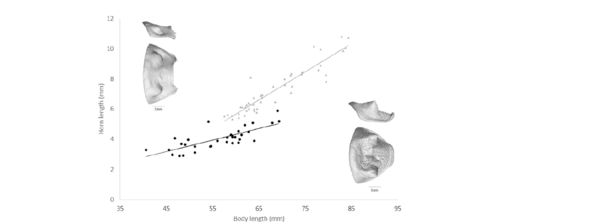
Taxonomists separate hissing cockroaches mainly by body size and by the size, shape, and elaboration of the pronotal shield, including the horns on the front of the body in males.[3] For example, Gromphadorhina oblongonota is large with long pronotal horns, while Aeluropoda insignis is smaller with reduced horns. Researchers measured these differences precisely with CT scanning of the horns (Figure 1).[3] In practice, a keeper or teacher can note rough size, color, and horn shape, but cannot reliably confirm a species by eye. Fine characters need a microscope and a specialist, and the variability of captive stocks makes casual identification unreliable.[2] Molecular tools exist but do not settle everything. Mitochondrial genomes have been sequenced for G. portentosa and other blaberids, yet mitochondrial protein-coding genes alone do not resolve relationships well, and richer genomic data (ultraconserved elements) give cleaner trees.[6][7]
Is the family tree settled?
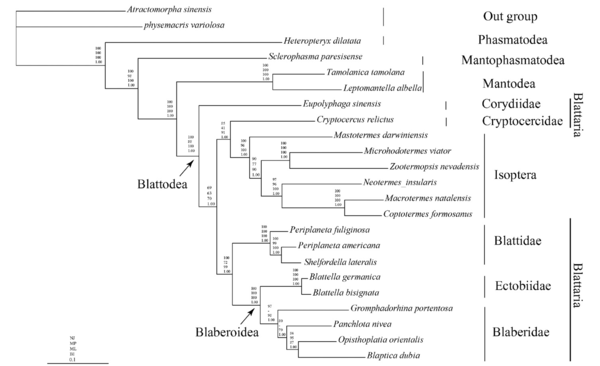
Not at the deepest branches. Studies that use large genomic datasets disagree about how the backbone of Blaberidae fits together, and about exactly where the hissing cockroaches (Oxyhaloinae) attach.[4][5] One analysis of ultraconserved elements places Diploptera plus Oxyhaloinae near the base of the family, but the support for the deep nodes is weak, with most of the signal showing genuine conflict rather than a clear answer.[4] A different study found that one dataset favored one subfamily as the earliest branch while another dataset favored a different one, both with strong statistical support.[5] The likely cause is biology, not sloppy work: incomplete lineage sorting and the type of data used pull the tree in different directions.[4][5] Mitochondrial genomes confirm that Blaberidae is a natural group but do not resolve the relationships among the hissing cockroaches beyond family level (Figure 2).[6]
Why does the right name matter for buyers and schools?
Correct species identification carries through to care, to the law, and to research. Gromphadorhina portentosa is reported as the only cockroach species legal for private ownership and breeding in the United States, so an accurate name is tied to staying within the rules.[8] Because these are insects, they fall outside the animal-care committee rules that govern vertebrate research, one reason they are used as study animals, and that exemption is tied to their identity.[9] For science, species identity decides whether results can be trusted and repeated. Closely related species differ in real biology: G. oblongonota and Aeluropoda insignis, for instance, invest differently in horns, aggression, and reproduction, so mixing them up would corrupt a comparison.[3] For a classroom, naming the animal correctly teaches the science honestly and keeps any published work pointing at the right species.
Open questions
How widespread is hybridization and mislabeling in captive colonies?
This is the biggest open question for keepers, and nobody has measured it. Mislabeling and captive hybridization are reported again and again in the hobby, but the scientific papers we reviewed do not put numbers on how often trade animals are misidentified or how often forms have been crossed. Settling it would take a systematic genetic survey: sampling animals across many suppliers and hobby lines, sequencing them, and comparing them against confirmed reference specimens of each species. We did not find such a survey in the literature for these genera.
Where do the hissing cockroaches sit on the cockroach family tree?
The deep branches of the Blaberidae tree are not resolved. Different genomic datasets place the hissing-cockroach subfamily (Oxyhaloinae) in different positions, often with strong but conflicting support.[4][5] Researchers attribute much of this to incomplete lineage sorting and to the type of molecular data used, rather than to a single correct tree waiting to be found. Better sampling and larger genomic datasets may sharpen the picture, but for now the backbone is genuinely unsettled.[4][7]
How many species are in each hissing-cockroach genus, and is there one key to tell them apart?
There is no single agreed count of how many species belong to the related Madagascar genera Gromphadorhina, Elliptorhina, Aeluropoda, and Princisia, and no one accepted key to identify them. The papers we reviewed do not settle the species lists or give a clean set of characters that separates the genera, and one report notes that species-level identification is hard because captive stocks are so variable.[2] Settling it would take a modern revision that examines type specimens, redescribes each species, and publishes a tested identification key.
References
- Clopton RE (2012). Synoptic revision of Blabericola (Apicomplexa: Eugregarinida: Blabericolidae) parasitizing blaberid cockroaches (Dictyoptera: Blaberidae), with comments on delineating gregarine species boundaries. The Journal of Parasitology. PubMed
- Bohn H, Sciberras A (2021). Cockroach (Blattodea, Blaberoidea) fauna of the Maltese Islands, with descriptions of two new species. Zootaxa. PubMed
- Durrant KL, Skicko IM, Sturrock C, Mowles SL (2016). Comparative morphological trade-offs between pre- and post-copulatory sexual selection in giant hissing cockroaches (tribe: Gromphadorhini). Scientific Reports. PubMed
- Evangelista DA, Nelson D, Kotyková Varadínová Z, Kotyk M, Rousseaux N, Shanahan T, et al. (2024). Phylogenomic analyses of Blattodea combining traditional methods, incremental tree-building, and quality-aware support. Molecular Phylogenetics and Evolution. PubMed
- Liu JL, Zhang JW, Han W, Wang YS, He SL, Wang ZQ (2023). Advances in the understanding of Blattodea evolution: insights from phylotranscriptomics and spermathecae. Molecular Phylogenetics and Evolution. PubMed
- Cheng XF, Zhang LP, Yu DN, Storey KB, Zhang JY (2016). The complete mitochondrial genomes of four cockroaches (Insecta: Blattodea) and phylogenetic analyses within cockroaches. Gene. PubMed
- Kovacs TGL, Walker J, Hellemans S, Bourguignon T, Tatarnic NJ, McRae JM, et al. (2024). Dating in the dark: elevated substitution rates in cave cockroaches (Blattodea: Nocticolidae) have negative impacts on molecular date estimates. Systematic Biology. PubMed
- McCallion K, Petersen K, Dombrowski DS, Christian LS, Lewbart GA, Dillard J (2021). Isoflurane anesthesia in the Madagascar hissing cockroach (Gromphadorhina portentosa). Journal of Zoo and Wildlife Medicine. PubMed
- Chua J, Fisher NA, Falcinelli SD, DeShazer D, Friedlander AM (2017). The Madagascar hissing cockroach as an alternative non-mammalian animal model to investigate virulence, pathogenesis, and drug efficacy. Journal of Visualized Experiments. PubMed
This deep dive backs the Where to Buy page.
Short, cited reads from the lab.